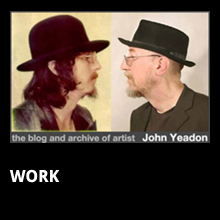
10.06.25 Talk delivered by John Yeadon ..
….. as member of panel with Exodus Crooks and Charan Singh.
Queer Work in Museums and Galleries.
Launch of Midland Art Papers issue 8.
Organised by University of Birmingham, at Birmingham Library.
Nice to know that I’m now old enough to be history.
Thanks to Gregory Salter for his article.
I had thought that the writing of art history had ceased ever since Francis Fukuyama got his 15 minutes of fame in 1992 by triumphantly declaring the ‘End of history’, supposedly we were entering this new epoch of Post-Modernity in which the big ideologies and political questions that animated the world were settled and that the traditional idea of history and progress, of modernisms trajectory and development, were no longer relevant. These big ideologies have been replaced by diversity and pluralism. And the market.
As Grayson Perry pointed out, it is as if ‘everything in art has already been done’. All we can do is to mix history up a bit, quote and appropriate earlier forms and styles out of context.
This is my favourite Peter de Francia quote on the constant search for originality. (Inaugural speech as Prof of Painting, RCA, titled Mandarins and Luddites):
“What comes to mind…is someone flinging open the door of an antique shop and loudly demanding if there is anything new to be had.“
If that was true in 1972 it is even truer today.
We have been stuck in this Groundhog Day for over 30 years now, or as George Orwell put it, “History has stopped. Nothing exists except an endless present…”
How much art history has been written about the past 30 years, how much analysis on contemporary themes?
In the 1980s I used to do a alternative history of art lecture this was essentially against the traditional Kenneth Clarke art history which was seen as linear, ‘white’, elitist, bourgeoisie and colonial – which tended to see art history as purely the history of styles and forms. We also see this in Alfred Barrs flow chart of MoMA as linear relationships, art exclusively coming from art. No reference to history, to the First World War or the Russian Revolution or the Great Depression in America. In fact, no reference to any ‘real’ history at all.
Nothing comes from nothing, everything has a history.
It’s true that art comes from art, but that’s not the full story.
In my alternative art history I began by comparing a Henry Ford Model T of 1909 with Picasso’s Les Demoiselles D’avignon of 1907 and posed the question, which was the most modern? The car seems to have dated much more and badly than the painting. Picasso’s painting, now over one hundred years old, and unfinished if not abandoned, would still be considered ‘modern art’ and is as fresh as the day it was painted, whilst the car is vintage. Technology seems to date very badly.
It would be impossible to give an alternative art history today in this pluralist art world. Any new art history would just become another one of many. There is a working class art history, a feminist art history, a black art history, a queer art history, psychological or political art history, an art history of social and economic structures, reflecting class relationships and social structures. The white male, sexist, colonial art history becomes just another history alongside all the other ones.
There is no alternative to everything.
Pluralism is like a black hole and will suck everything in.
Charles Harrison stated. “If anything goes, who decides the anything?”.
Pluralism offers the freedom to do anything we wish, but does not provide the ideology to discriminate.
And worst, artists are free to do whatever they like because society don’t care what they do.
Or as Hal Foster pointed out in the 1980s – if “all is permitted, nothing means jack shit..“
It’s very difficult to be anti pluralistic, it feels undemocratic, its like being against diversity.
‘Beyond pluralism’ – what would that look like?
In the late 1970s I taught Keith Piper and Eddie Chambers who first met each other in Coventry and went on to form the nationally and internationally significant BLK Art Group with Donald Rodney, Claudette Johnson, and others. At that time Eddie began creating the Black Art Archive which was essentially his slide collection. Eddie is now a Professor in Art History on African Diaspors at University of Texas, Austin.
So these new political and social categories of Black art histories, of feminism and LGBTQ offer new contexts of art history and space for research and curatorial enquiry.
At Coventry University I also did a seminar series on Art and Sexuality; we are talking 40 years ago. Initially I though this would be interesting to some students but not all, and though Peter Webb had left a historical foot print on the course in Coventry, erotic art was probably a niche concern. However it seemed that art of any period – Ancient Egypt, Greek, Roman, their Creation Myths, Medieval, Renaissance, to the 20th century, they where full of sex. Or as with, individuals: from Leonardo to Picasso or Michelangelo to Duchamp, Botticelli to Turner, Artremisia Gentileschi to Jo Spence, Fragonard to Hockney, Caravaggio to Francis Bacon, Bonnard to Eric Fischl. Sexuality is fundamental to art history and any history of art that leaves it out would be an incomplete history.
Was Michelangelo a gay artist? Was Shakespeare a gay play writer?
Well, Shakespeare and Michelangelo had their pronoun problems, their Love Sonnets were vandalised, where ‘she’ was substituted for ‘he’, ‘him’ changed to ‘her’ etc. So, their work was transformed and hetrosexualised to fit 19th century morality. The usual erasing of queer narratives from history.
Alan Sinfield in his book on Wilde, says – “The word ‘homosexual’ was invented in 1869 so before then homosexuality did not exist and by the same token neither did heterosexuality”. Certainly homosexuality did not exist as an identity or a orientation, with a community but simply as a sexual act, which anybody could perform. So it would be wrong to view queer history in our own LGBTQ+ terms of reference.
A few years ago the Herbert Art Gallery in Coventry exhibited my Disco Drawing along with other works from their permanent collection: among them was Lisa Gunn, (an ex-student who suffered a horrific vehicle crash, was nearly killed, leaving her with spinal injuries), and also a Caribbean artist and others I cannot remember. So this was a small group of gay, black, disabled, feminist works. For me this felt more like fulfilling Coventry Council’s equal opportunities requirements than a coherent statement. I didn’t understand why we had been grouped together, some sort of ‘outsider group’ I suppose. This group show just wasn’t thought through, it lacked purpose, just ticking the ‘equal opportunities’ box.
In 2017 the Coming Out: Sexuality, Gender and Identity exhibition was held at Liverpool Walker Art Gallery, and which also came here in Birmingham. Marking the 50th anniversary of the partial legalisation of male homosexual acts in England and Wales, the exhibition apparently explored sexuality, gender and identity since 1967.
Prior to this the Tate had an exhibition Queer British Art, 1861 up to 1967 which was wonderful.
However the Coming Out exhibition in Liverpool was a disappointment as it claimed it was the findings of over two years research into LGBT history, visual culture from the Walker Art Gallery and Arts Council Collections. Revealing hidden queer histories and institutional blind spots. There was Hockney, Bacon, Grayson Perry, Sarah Lucas, Steve McQueen even Warhol got a look in celebrating legalisation in England and Wales. This was same old, same old, it would have taken anyone two minutes to come up with that lot not two years. Of course there were some less familiar artists but not the institutional systemic oversights, or new narratives that was promised.
My point being that in the area of LGBTQ art there is enormous research potential from which exhibitions can be curated. (Like Newcastle artist Lizzie Rowe or Liverpool’s Yankel Feather, both deceased).
I am quite aware that I’m not the target audience for these sorts of major national exhibitions. But I do think you can be accessible to a breadth of levels of interest and you don’t have to dumb down to the lowest common denominator which sometimes seems to be an 8 year old child. Or rather, the parents on behalf of that 8 year old child.
Many LGBTQ artists have shown courage being unapologetically visible in the face of prejudice. Being visible might seem like a low bar but many have face censorship by omission and when people are trying to neutralize you, being visible isn’t a low bar.
At the moment it is trans people who are in the line of fire facing similar prejudice that was thrown at gay men and lesbians in the 70s and 80s, it’s all very familiar. I applaud their visibility and courage, curators and galleries need similar courage to embrace what might seem controversial.
Artists and galleries I’m sure would like to initiate change in society. It seems to be our purpose.
However I think if art does change things it doesn’t necessarily change them for the better. There is no such think a apolitical art, essentially most art supports the status quo and when the status quo is under threat art is a trusted ally of conservative forces, even a supporter of fascism.
I would now like to share some of my thoughts on art changing things…
Bronowski asked “Did the Marriage of Figaro cause the French Revolution?”
Revolutions are a significant form of social change and it has been said that revolutions have their accompanying art form, there was the novel for the Russian Revolution, Pageant for the French Revolution, Mural painting in Mexico and song in Chile.
Culture can be an indicator of change. Art can predict, it can show that the new is knocking at the door.
However culture isn’t inherently progressive or liberating. Can art by itself change anything?
It seems universally accepted that art changes society; this is the unquestioned presumption that underpinned Coventry’s year of City of Culture and is a false notion.
The City of Culture claims the use of art and culture to promote economic growth and social cohesion, health benefits and promised opportunities for artists in the city. Whilst artists were parachuted in and Coventry-based artists were sidelined.
Martin Green the CEO of Hull City of Culture got it right when he said that “it’s not about art but redevelopment”.
I think society changes art rather than, or more than, art changing society.
No matter what the intention of the artist is, the viewer will dictate the meaning. The audience, as Duchamp observed, finishes the work. Pepe the Frog was a popular on-line cartoon character and is an extreme example of the audience dictating and indeed changing meaning and the intentions of its creator. Pepe the Frog was originally apolitical and regarded as a sad frog meme but from 2015 onward it became a symbol of racism and antisemitism, appropriated by the alt right white supremicist nationalist movement and now an icon of hate. So from something cute and innocent Pepe has become sinister.
Lena Radić was a 17 year old partisan hung by the German army in 1943. The photograph of this young Yugoslavian resistance fighter being strangled to death from a tree was used as Nazi propaganda to evoke fear and intimidate the population. Lena resisted identifying communists amongst their captives during torture. Finally with the rope around her neck the Nazis offered to spare her life if she submitted to their requests. From the makeshift ‘gallows’ she bravely called for the Yugoslavians to rise up against the Nazis. The story of her heroism spread throughout Yugoslavia and the Nazi photograph of her imminent death became a courageous image of defiance for the Yugoslavs. The Nazis had to withdraw their propaganda as it had been turned upside down. Images have no fixed meaning: they can transform with a change of the narrative text even become to mean the opposite from what was intended.
In the 1970s there was thought to be such a thing as the ‘purely visual’, but there is no such thing as the ‘purely visual’, it has always been image and text. The narrative associated with the image will change as society changes. And there is a lot of text and narratives: critics, art historians, teachers, journalists, books, magazines, libraries, even artists and ‘this’ gathering here today. It’s a very noisy subject. Lot of words.
The sculpture of Ancient Greece is still regarded as significant and meaningful to us even though our society is unlike that of ancient Athens. We do not share their Gods, we don’t keep slaves, our social relationship to sexuality is very different, and we aren’t a misogynist society (well, not to the extent Ancient Greece was).
One of art’s distinctive features is its relative independence as it develops. The fact that works of art are connected historically with particular social structures does not mean that they lose their significance when these social structures disappear.
In fact the meaning of these sculptures has change a number of times. Indeed we view the past in our own terms. Some times art is even physically changed to fit the ideology of the time, and 18th and 19th century archeologists found Egyptian, Greek and Roman’s sexuality hard to take and chopped off the penises on the sculptures (you can see some of these marble penises in the Secret Cupboard in the British Museum, though you still need special pass to view.) They even scrubbed the so called Elgin Marbles to get to a white purity to fit their aesthetic beliefs, even though originally these sculptures were painted in bright colours.
Picasso’s Guernica was famously kicked around Europe and the USA as a political football. Its meaning continually being modified. In 1968 Franco wish the painting to be returned to Spain, Picasso refused. After Picasso’s death and Franco’s death, Guernica’s return to Spain in 1981 defined Spain’s transformation into a democratic constitutional monarchy. Not the republic that the communist artist would have supported as a condition for its return nor the restoration of “public liberties and democratic institutions” that Picasso insisted upon. With the paintings return to Spain its function had changed yet again becoming a national emblem.
Western culture as a civilising force seems totally flawed.
When in London Mahatma Gandhi was asked, “What do you think of western civilization?” he retorted “I think it would be a good idea”.
George Steiner the American critic in the preface to Language and Silence stated in 1967 “.. we know that a man can read Goethe or Rilke in the evening, that he can play Bach and Schubert and go to his day’s work at Auschwitz in the morning“.
Jewish and Polish music was banned in Auschwitz however for the Auschwitz orchestra music enabled the players to survive and with no sense of irony the orchestra played marches as the ‘slaves’ went to work and returned. The orchestra was German propaganda for visitors and newsreels of the camp, a tool to boost morale. The cellist Anita Lasker-Wallfisch played Schumann’s Traumerei often requested by Dr Mengele, the torturer and murder of twins (children).
Before WW1 Germany was regarded as the most cultured country in Europe. It had the best composers and classical music was the lifeblood of the German people. Yet some of these cultured people committed the worst atrocities, the most monstrous, heinous crimes against humanity of 20th century. Culture doesn’t protect you from the beast. Or from being the beast.
Reinhard Heydrich – the Butcher of Prague – was cultured, played the violin and by all accounts he was a good family man. Whilst Wellington destroyed his violin as he did not think it compatible with warfare.
Should we disassociate art from the culture that gave birth to it or the life and behaviour of artist. Can we divorce Italian Futurism from Mussolini’s fascism? Or Wyndham Lewis from his admiration of Hitler? Or Eric Gill for his sexual crimes? Orff’s Carmina Burana is no longer associated with the Hitler Youth mainly because few know its history. Barenboim took Wagner to Israel to mixed reception but felt it necessary to do. Maybe some social contexts are impossible to ignore. Why are John Heartfelt’s montages relevant today they seem to go beyond ‘agit prop’ and anti-Hitlerite fascism? Is it because fascism is still with us or that there is something aesthetic in the work that overrides the social structures that gave it reason for being?
So why do we bother if we aren’t going to change anything? Why do I bother? What is the point? A question artists regularly ask themselves.
I believe resistance isn’t futile, resistance requires you to stand up. Being visible for LGBTQ+ is resistance in itself.
The visual arts tends to spill out into other areas, broader theories on culture.
Art can be part of initiating change but there has to be the social need and it is activism, struggle, possibly associated with the art, that effects social change.
In the end, I’m afraid I reluctantly sympathize with Jonathan Swift’s comment –
“To vex the world rather than divert”.
This entry was posted on Tuesday, July 8th, 2025 at 1:18 pm
You can follow any responses to this entry through the RSS 2.0 feed.